Custom OpenSpec schemas packaged as copyable folders under openspec/schemas/.
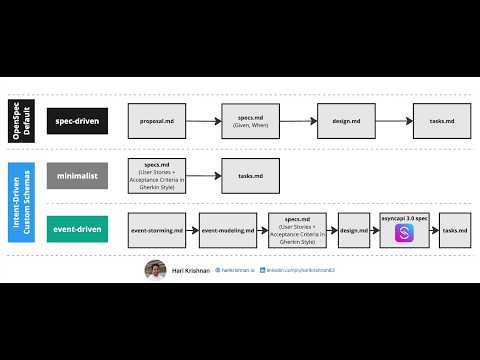
Default OpenSpec includes the spec-driven schema, which is a strong general-purpose workflow. This repo adds more focused workflows for specific delivery contexts, and also demonstrates how to customise OpenSpec for different styles of work.
Copy the schema folder you want from https://github.com/intent-driven-dev/openspec-schemas/openspec/schemas into one of these locations:
-
Project Local: Create
openspec/schemas/in your project (if it does not exist), then copy your schema toopenspec/schemas/<schema-name>/. -
User Level: Copy your schema to
$HOME/.openspec/schemas/<schema-name>/.
Once the schema exists in either location, update openspec/config.yaml to activate it.
config.yaml guidance:
- Set
schema: <schema-name>. - Ensure
ruleskeys correspond to artifact IDs in your schema'sschema.yaml(artifacts[].id). - For example, when using
minimalist, artifacts arespecsandtasks, so userules.specsandrules.tasks.
schema: minimalist

context: |
 Tech Stack:
  - Pure HTML5, CSS3, vanilla JavaScript
  - No build tools, package managers

rules:
  specs:
    - Note accessibility requirements (WCAG 2.1 AA)
  tasks:
    - Include responsiveness checks.
Artifact alignment source: openspec/schemas/minimalist/schema.yaml (specs, tasks).
Fast path from spec to execution using user-story requirements and Gherkin acceptance-criteria style.
For more details, see openspec/schemas/minimalist/README.md.
Structured workflow for event-centric systems with Event Storming discovery followed by AsyncAPI specification.
For more details, see openspec/schemas/event-driven/README.md.